


Tattoo Cartridge Needle Buying Guide
Choosing the right tattoo cartridge needle is about more than simply picking a needle type. Your tattoo style, line weight, shading technique, needle diameter, taper, and grouping all influence how a cartridge performs.
With so many configurations available, understanding what each specification means can make it much easier to build the right setup for your work. If you're a beginner tattoo artist, these specifications can seem confusing at first. Learning what each one means will help you make more informed choices instead of simply choosing a cartridge based on needle count or appearance.

1. What Do the Different Tattoo Needle Configurations Mean?
Tattoo cartridge configurations describe how the needles are grouped and arranged. The most common types include:
| RL (Round Liner) | Lining and fine details |
| RS (Round Shader) | Soft shading and smaller areas |
| CM (Curved Magnum) | Shading, blending, and coverage |
| M1 (Magnum) | Shading and color packing |
The right configuration depends on your technique, while diameter, taper, and grouping further influence how the cartridge performs.
2. How Does Needle Diameter Affect Your Tattoo?
Needle diameter refers to the thickness of each individual needle. It can influence line weight, pigment delivery, and the overall feel of the cartridge.
| Smaller Diameter | Generally suited to finer lines and delicate details. |
| Medium Diameter | Offer a balance between precision and pigment delivery and can work well for everyday lining and detail work. |
| Larger Diameter | Can provide stronger lines and higher pigment delivery for techniques that require more coverage. |
For example, a 3RL in a smaller diameter can produce a very different result from a 3RL with a larger diameter, even though both cartridges share the same basic configuration.
This is an important point for beginners: the same needle grouping does not always produce the same result. When comparing cartridges, look at the full specification rather than the needle count alone.
3. What Does Needle Taper Mean?
Taper describes how gradually the needle tip narrows toward its point. It is another important specification that can influence how the needle interacts with the skin and delivers pigment.
| Short Taper | Has a shorter transition to the tip and can provide a more concentrated needle point. |
| Medium Taper | Offers a balance between precision and pigment delivery. |
| Long Taper | Creates a more gradual needle point and is often preferred for delicate lines and detailed work. |
The right taper depends on your technique and the type of result you want. For artists focused on fine lines and controlled detail, taper becomes particularly important when combined with a smaller diameter and precise needle grouping.
How Do You Match Needle Specifications to Your Technique?
Once you understand configuration, diameter, taper, and grouping, you can start combining these specifications according to your technique.
| Fine Line | Smaller diameter · RL · Longer taper |
| Bold Lining | Larger diameter · RL |
| Small Details | Fine RL · Smaller grouping |
| Soft Shading | RS · RM |
| Blending | RM / CM |
| Color Packing | RM / M1 |
| Dotwork | Fine RL · Smaller grouping |
These are starting points rather than fixed rules. For beginners, they can serve as a useful starting reference when building a basic cartridge selection. Experienced artists often adjust their cartridge selection based on their machine, hand speed, preferred needle depth, skin type, and personal technique.
The most useful approach is to understand what each specification changes, then build your cartridge setup around the way you actually tattoo.
Which JCONLY Cartridge Needle Series Is Right for You?
JCONLY offers four cartridge needle series, each with a different focus. For beginners, the key is not to look for the "best" series, but to understand which series and specifications fit the techniques you are learning.
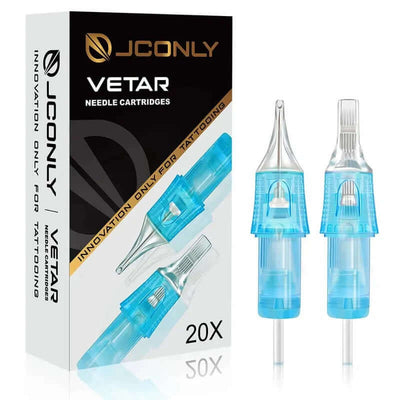
| VETAR 💙 | Classic / Versatile | Broad range of configurations |
| VINK 💚 | Stability‑focused | Premium needle stabilization |
| VINK Titanium 💚 | Titanium construction | Advanced stabilization & tip placement |
| VETAR S Fineline 🩷 | Fineline / PMU / SMP | Precision & enhanced stability |
The best cartridge needle is not necessarily the most advanced one.
It's the one that matches your technique, preferred specifications, and workflow. As you gain experience, your preferred configurations may change—and that's a natural part of developing your own tattooing style.

Featured collection


JCONLY VETAR Tattoo Cartridge Needles Round Liner (20pcs/box)


JCONLY VETAR Tattoo Cartridge Needles Round Shader (20pcs/box)


JCONLY VETAR Tattoo Cartridge Needles Curved Magnum (20pcs/box)

